
Female figure
Benin Kingdom Court Style
Early 19th century
Benin Kingdom Court Style
Early 19th century
Paul Tishman was often asked why he decided to collect African art. He replied,
"How does one fall in love?"
In 1959, Paul and Ruth Tishman bought two pieces of art from the Benin kingdom, including an exquisite ivory female figure. Over the next 20 plus years, the Tishmans would build one of the great private collections of African art. Their goal--to acquire works from all the major art traditions in the continent, a dream that would be almost impossible to achieve today.
The majority of the objects the Tishmans collected are from west and central Africa, reflecting the collecting practices of their time. Looking at the collection today, one can focus on questions of history, deliberate the differing approaches to the human ideal or consider the messages of power and status conveyed through form, gesture and material.
Since the mid-1960s, this collection has greatly influenced the study of African art. Through exhibitions and publications, it has helped define African art and set aesthetic standards of quality.
The Tishmans' desire to share their African art with as many people as possible led to the sale of the collection to the Walt Disney Company in 1984. While the original plan of a permanent exhibition space at Epcot in Florida was never realized, the Walt Disney Company proved to be generous stewards, making the collection available for numerous exhibition loans and publications.
In 2005, Walt Disney World Co., a subsidiary of the Walt Disney Company, gave all 525 objects in the Walt Disney-Tishman African Art Collection to the National Museum of African Art, Smithsonian Institution. This exhibition and the publication African Vision: The Walt DisneyÐTishman Collection continue the tradition, begun by Paul and Ruth Tishman and maintained by the Walt Disney Company, of sharing this great African art with the world.
The majority of the objects the Tishmans collected are from west and central Africa, reflecting the collecting practices of their time. Looking at the collection today, one can focus on questions of history, deliberate the differing approaches to the human ideal or consider the messages of power and status conveyed through form, gesture and material.
Since the mid-1960s, this collection has greatly influenced the study of African art. Through exhibitions and publications, it has helped define African art and set aesthetic standards of quality.
The Tishmans' desire to share their African art with as many people as possible led to the sale of the collection to the Walt Disney Company in 1984. While the original plan of a permanent exhibition space at Epcot in Florida was never realized, the Walt Disney Company proved to be generous stewards, making the collection available for numerous exhibition loans and publications.
In 2005, Walt Disney World Co., a subsidiary of the Walt Disney Company, gave all 525 objects in the Walt Disney-Tishman African Art Collection to the National Museum of African Art, Smithsonian Institution. This exhibition and the publication African Vision: The Walt DisneyÐTishman Collection continue the tradition, begun by Paul and Ruth Tishman and maintained by the Walt Disney Company, of sharing this great African art with the world.

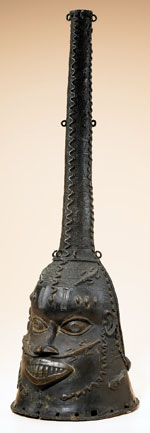
Crest Mask
Bamileke peoples
Late 19th century
Bamileke peoples
Late 19th century